
Developing your abdominal muscles improves your body aesthetics, core stability, posture, lower back health, and control of everyday movements. Strong abs help distribute weight correctly, improve your technique for basic exercises, and reduce the risk of injury. You can train your abdominal muscles in various conditions – at home, in the gym, or outdoors. The main thing is to consider technique, gradual load, and attention to sensations.
How the abdominal muscles work
When we talk about the abdominal muscles, we usually mean the rectus abdominis muscle, which helps bend the torso forward. But a pronounced relief and stability in the centre of the body are not formed solely by this muscle. The oblique muscles, which provide rotational and lateral movements, and the deep transverse muscle, which is responsible for stabilisation and maintaining internal pressure, are always involved. Therefore, for full development, it is important to work the entire complex and not limit yourself to exercises that only lift the torso.
Training this area requires regularity, attention to technique, and an understanding of which muscles are involved in the work. Below are exercises that can be adapted for both beginners and those who have been training for a long time.
1. Crunches on the floor (Basic Crunches)
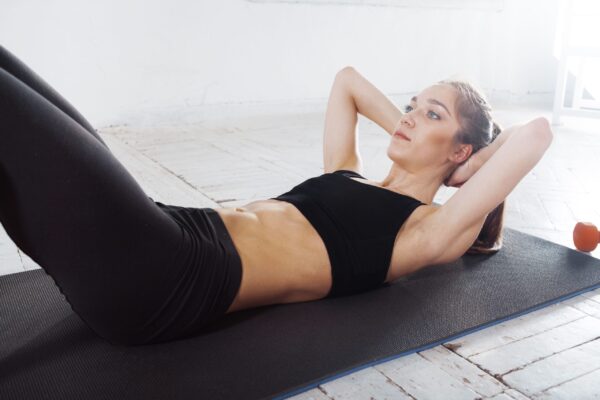
Lie on your back with your knees bent so that your feet remain on the floor. Place your palms lightly behind your head or cross your arms over your chest. Slowly lift your shoulders up, as if trying to bring your chest closer to your pelvis. Do not pull your head with your hands and do not make sudden movements – the centre of the exercise should be in the abdominal area. Lower yourself smoothly, maintaining control over your abdominal muscles.
2. Bicycle Crunches
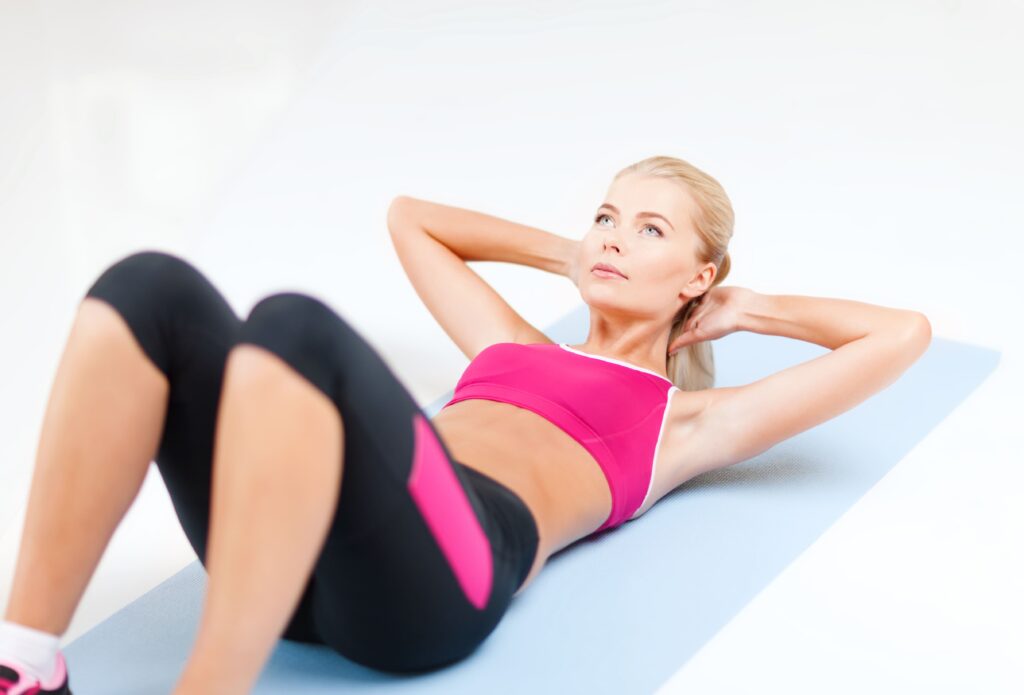
Starting position: lie on your back. Raise your legs off the floor and bend them. Pull one knee toward your chest while simultaneously turning your torso and bringing the opposite elbow toward that knee. Then switch sides at a relaxed pace. Imagine that you are ‘pedalling,’ but focus on smoothness and abdominal tension rather than speed.
3. Reverse Crunches
Lie on your back with your arms stretched out alongside your body or holding onto something stable. Raise your bent legs so that your thighs are perpendicular to the floor. As you exhale, pull your pelvis up, bringing your knees toward your chest. Do not swing your legs or use momentum. Lower yourself slowly, trying to keep your lower back pressed against the floor.
4. Decline Sit-Ups
Sit on an incline bench and secure your feet. Lower your torso back as you inhale until you feel tension in your abs. Return to the starting position as you exhale, lifting your torso smoothly. If the exercise seems too easy, slow down the movement or hold your arms above your head to increase the load.
5. Hanging Leg Raises
Grab the bar and maintain a straight line with your body. Lift your legs, and make an effort not to swing. Your arms should be merely a means of support, not a power to assist. If it is hard for you to lift your legs straight, do it in a bent position and gradually increase the angle. The drop should be slow and controlled.
6. Forearm Plank
Support yourself on your forearms and toes. Keep your body in a straight line: do not arch your back or raise your pelvis too high. Pull your stomach in slightly and breathe calmly. The duration of the hold is individual – correct posture is more important than duration.
7. Side Plank
Lie on your side and lift your body, resting on your forearm. You can place your feet on top of each other or slightly shift them for stability. Your torso should be straight, without sagging or tilting. You can keep your free arm along your body or stretch it upwards. Hold the position for the required time, then switch sides.
8. Russian Twist
Sitting on the floor, lean back a bit until you can feel your abs working. It is possible to keep your feet on the floor or raise them if you want to make the exercise more difficult. Twist your upper body to the right then to the left, use the abdominal muscles and not the arms. The operation should be seamless and regulated, without sudden movements.
9. Scissors (Flutter Kicks)
Lie on your back with your arms alongside your body. Lift your legs off the floor and perform short cross kicks alternately. Keep your lower back pressed to the floor and do not hold your breath. The lower your legs are to the floor, the greater the load.
10. Upper body lifts on the upper block / Cable crunches
While holding the cable handles, kneel down in front of the upper block. Bring your torso down, rounding your back and attempting to get your chest closer to your belly. Your elbows must be pointing downwards, not outwards. The movement has to be control by your abs, without the help of the arms for pulling or the back for leaning.
11. Abdominal Vacuum
Stand up straight, exhale as deeply as possible and gently pull your stomach in, as if trying to bring your navel closer to your spine. Breathe shallowly, keeping your abdominal muscles contracted. The vacuum can be performed standing, sitting or on all fours – choose the position that makes it easier for you to control the movement.
Final thoughts
Abdominal training is a combination of various exercises, proper technique and breath control. Success does not come in a week. Systematic training strengthens the deep muscles of the torso, helps improve posture and makes body movements more confident and stable. If you train regularly and your approach is well thought out, your abs will become a visual highlight and a reliable foundation for all physical activity.
Comments are closed